
The Most Kentucky Jack-o-Lanterns Ever
Download pumpkin-carving stencils with a Kentucky flair!
Remember when you were a kid and carving a pumpkin was, more or less, just about adding some eyes and jagged teeth? Yeah, it seems the game has stepped up a lot since then.
Here in Louisville, there's the Jack-O-Lantern Spectacular at Iroquois Park, where 5,000 intricately carved pumpkins line a 1/4 mile walking trail to create a nighttime art installation. Over in Lexington, my alma mater, Transylvania, is hosting its fifth annual PumpkinMania tomorrow night.
Image via Transylvania University
Clearly, an old-school snaggle-toothed pumpkin just doesn't cut it these days. In honor of National Pumpkin Day and the upcoming Halloween holiday, I set out to carve the most Kentucky Jack-o-Lanterns ever. I went with three patterns that symbolized some of my very favorite aspects of my Kentucky life: my team, my city, and my dogs. I started with three pumpkins and a little fuel.
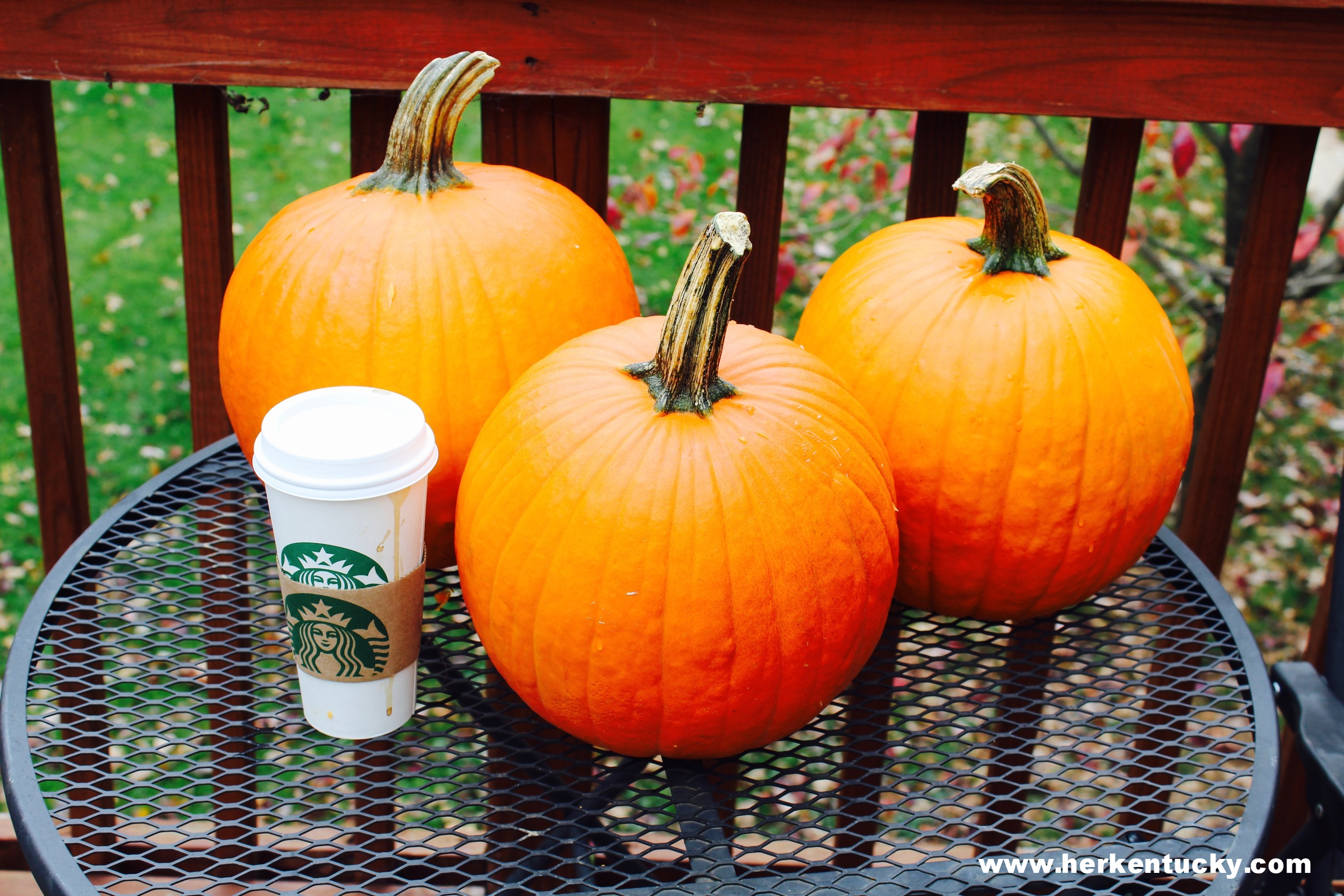
Then, I thought of some of the designs that would work best for my skill level and my love of the Commonwealth. I had a few ideas:
School Spirit
Here in the Bluegrass State, we love our sports teams a lot. Your college (or high school) logo makes a great pumpkin design. I downloaded this Kentucky Wildcats pumpkin template. I also found a WKU Hilltoppers, and it would be easy to create a template from this Louisville Cardinals logo or this UPike Bears logo.
Max investigates the pumpkin-carving process.
Famous Kentuckians
This takes a level of pumpkin-carving skill that I simply can't master, but famous Kentuckians would make for a kick-ass set of Jack-o-Lanterns. Here's an Abe Lincoln pattern. This guy could easily be converted to Colonel Sanders. I even found a Johnny Depp pumpkin on Pinterest and a Loretta Lynn in a country music magazine!
City Specific
Of course, here in Louisville, we have the fleur-de-lis to symbolize our city; this one belonged on my front porch for sure! With a little creativity, you could make a bourbon barrel, a racehorse, a bridge, or a local landmark!
Country Livin'
If you love the Kentucky country life, you could create a barn or a deer, or any other critter you like. If you follow HerKentucky on Instagram, you know that I'm obsessed with my dogs. I downloaded a Labrador Retriever stencil for Max and Sophie; you can find many popular breeds here.
Here's to a Happy Halloween, y'all! Hope you carve the perfect pumpkin for your Kentucky Home!
Pink and White Dresden Plate Quilt
This week's HerKentucky Quilt of the Week is a pink and white Dresden Plate. I love this pattern. My granny made one for me in pink with burgundy accents. I've seen this pattern in so many different color schemes and I always think, "Oh, I love that pattern!" Check out this Christmas Dresden Plate Pattern on Pinterest, and this one! And click here to learn more about the pattern and download a template to make one of your own!

Five Things You Probably Don't Know About Dwight Yoakam
Dwight David Yoakam was born on October 23, 1956 in Pikeville, KY, to keypunch operator Ruth Ann Tibbs Yoakam and gas station owner David Yoakam. Soon after, his family moved from their Floyd County home to Columbus Ohio. Dwight remained fiercely proud of his Kentucky roots, and he sang of the trip North up U.S. Highway 23 that many Eastern Kentuckians -- like his own parents -- were forced to take in order to find factory jobs.
In honor of Dwight Yoakam's birthday, here are five facts you probably didn't know about the singer and actor:
- Dwight was briefly enrolled at the Ohio State University, but dropped out in order to move to Los Angeles and pursue a career in entertainment. He was later awarded an honorary doctorate degree from Ohio Valley University in Parkersburg, WV.
- He has released four albums that were comprised solely of cover songs, including one album of Buck Owens songs.
- Dwight's acting career includes roles in Slingblade, Panic Room, Wedding Crashers, and Bandidas.
- He owns a food brand known as Bakersfield Biscuits.
- Johnny Cash once said that Yoakam was his favorite country singer.
Happy Birthday, Dwight!
Breast Cancer Facts in a Sea Of Pink

Dr. Shannon Tierney
I am so thrilled that my sorority sister Shannon Tierney agreed to write a HerKentucky guest post about breast cancer awareness month, "pinkwashing", and the facts that every woman needs to know.
I've known Shannon since our undergrad days when she was our Phi Mu pledge class president. These days, she's a Seattle-based breast oncology surgeon, a mother of two, and an active patron of the arts. Shannon is an Ashland, KY native who holds a B.S. from Transylvania University, an M.S. from the University of Virginia, and an M.D. from Washington University in St. Louis. -- HCW

In recent years, the colors of October seem to have changed from red, orange, and gold to pink, pink and more pink. I have always loved pink, well before becoming a breast cancer surgeon, even before my Phi Mu days in college, but like many of us, I find the pink of October overwhelming, especially at this point in the month. I appreciate and endorse the continued focus on breast cancer, but often the true issues, the important information, get drowned out by the rah-rah-rah of the awareness campaigns. Many women (and men) are “aware” of breast cancer, but never truly become aware of what it really is, what it really means, until they find themselves dealing with the cold terror of a palpable mass or a call-back after mammogram.
They need information, not just pink blenders.(Click to tweet!)
Breast cancer is the most common cancer in women in the US, affecting 1 in 8 women in their lifetime. Breast cancer usually involves cells that line the milk ducts or lobules which then undergo mutations that escape the body’s usual self-protection mechanism. These cells develop the ability to multiply rapidly, grow, invade, attract blood vessels for nutrients, and set up camp elsewhere in the body.
Due to screening with mammograms, most cancers are caught early. The survival rate from breast cancer has improved substantially, in part due to early detection and in part due to advances in treatment, but it is still the second leading cause of cancer death in women. Cancers can develop that are not seen well on mammograms, or that grow rapidly enough that they are felt in the breast in between mammograms, but these days, most are caught on screening before they are that large. Mammograms are a large source of stress for many women, not to mention uncomfortable, though we haven’t yet developed a better technology to replace them. Many women do get called back for additional images, which often are enough to allow the radiologist to see clearly and rule out any abnormalities. Others have to go on to ultrasounds and needle biopsies, but often the radiologist can predict the likelihood of finding anything serious (the BIRADS score.) Anything that is abnormal or cancerous is usually leads to a referral to see a breast surgeon. Abnormal cells often are removed to be sure that’s all they are – that there is nothing more serious in the area adjacent to that. Women with cancer often undergo additional imaging, which may include MRIs, bone scans, or CT scans, to determine the best course of treatment.
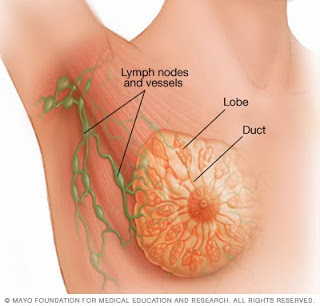
Image via Mayo Clinic.
About 30% of breast cancers are ductal carcinoma in situ, or DCIS, which is the non-invasive form of breast cancer. The cancerous cells are (currently) confined to the milk ducts. These cancers are still treated similarly to invasive breast cancers (minus chemotherapy) because at least half will progress to invasive cancer. Someday, hopefully, we will be able to determine which will progress and which won’t, so that we can reduce the amount of treatment that women need. We are already making progress with that, developing tests which may tell us which women with DCIS can safely skip radiation treatment after lumpectomy. The remaining 70% are invasive cancers, which are highly likely to spread if not treated.
Treatments usually involve surgery to remove the cancerous cells in the breast and usually any in the lymph nodes under the arm. For smaller cancers, the woman can choose whether to have a lumpectomy, removal of the tumor only, or a mastectomy, removal of the entire breast. There is no survival advantage to having a mastectomy, though there may be other advantages. It’s largely a personal choice. Surgery may be followed up with radiation for women who have had lumpectomies or who have had mastectomies for extensive cancer. For breast cancers that are sensitive to hormones (a trait they inherit from the normal, healthy breast cells), antiestrogen pills will usually be used, and sometimes can be used alone without chemotherapy. Cancers that are hormone negative usually require chemotherapy, unless they are quite small. There are other “targeted” treatments that are directed towards unusual characteristics of breast cancer cells, which hopefully minimize the damage to other healthy cells.

For some women with small cancers, treatment may be short and relatively easy. Others may have months of treatment, or several reconstructive surgeries. However, the earlier that breast cancer is caught, the more options are available for treatment. I understand the fear and denial that may take over when the discussion turns from pink ribbons to the reality of breast cancer, but that tends only to prolong the worry and limit the options. So, if the overwhelming pinkness of October encourages someone to go ahead and get that first mammogram, or to check out that lump that is probably nothing, then bring on the pink.
The HerKentucky Guide to Big Blue Madness
Tonight's the night, BBN. Big Blue Madness, our first glimpse at the 2016 Wildcats. The greatest recruiting tool in college basketball, where we've learned over the years that Drake is a 'Cats Fan, and that at least one Miss America bleeds blue and where we've seen Coach Pitino on a Harley, Mr. Keightley jump out of a cake, and as many sick dance moves as Coach Mitchell cares to lay down. In honor of tonight's event, here's some Big Blue Madness Trivia for y'all.

- The first Kentucky Wildcats late night practice was held on October 15, 1982. Although UK Coach Joe B. Hall was not the first coach to hold an open scrimmage or practice to kick off basketball season, his "Midnight Special" is credited with popularizing the custom.
- Big Blue Madness was held in Memorial Coliseum from 1982-2004 and was moved to Rupp Arena in 2005.
- Although the free event welcomes thousands of Wildcats super-fans, the unofficial guests of honor are always high schoolers. The blue chip recruits whom we hope to sway toward the Big Blue Nation are conspicuously in attendance. The day after the 1991 Big Blue Madness, all four recruits in attendance -- Rodrick Rhodes, Jared Prickett, Tony Delk, and Walter McCarty -- verbally committed to UK.
- Some of the celebrities who've attended Big Blue Madness include Drake, Secretariat owner Penny Chenery, Miss America Heather French, and, of course, Ashley Judd.
- The 2002 Big Blue Madness celebrated the 100th anniversary of Kentucky Basketball. A giant birthday cake was brought to center court prior to the player introductions, with Mr. Wildcat, Bill Keightley, stealing the show by jumping out of the cake.
- When it became clear that the Internet was here to stay, tickets to BBM became even harder to acquire. The 2000 Big Blue Madness market the first time that tickets were available for online purchase; all 700 were distributed in 13 minutes. The remaining 8,000 were gone in 10 minutes to those waiting in line.
- In 1995, seniors Tony Delk and Walter McCarty made their grand appearance as "Cat"man and Robin.
- And, of course, in 2012, this happened. And it was the best.
The KY Kernel has a great rundown of this year's 'Cats. I don't know about y'all, but I sure am excited to meet them!
Go Big Blue!!!
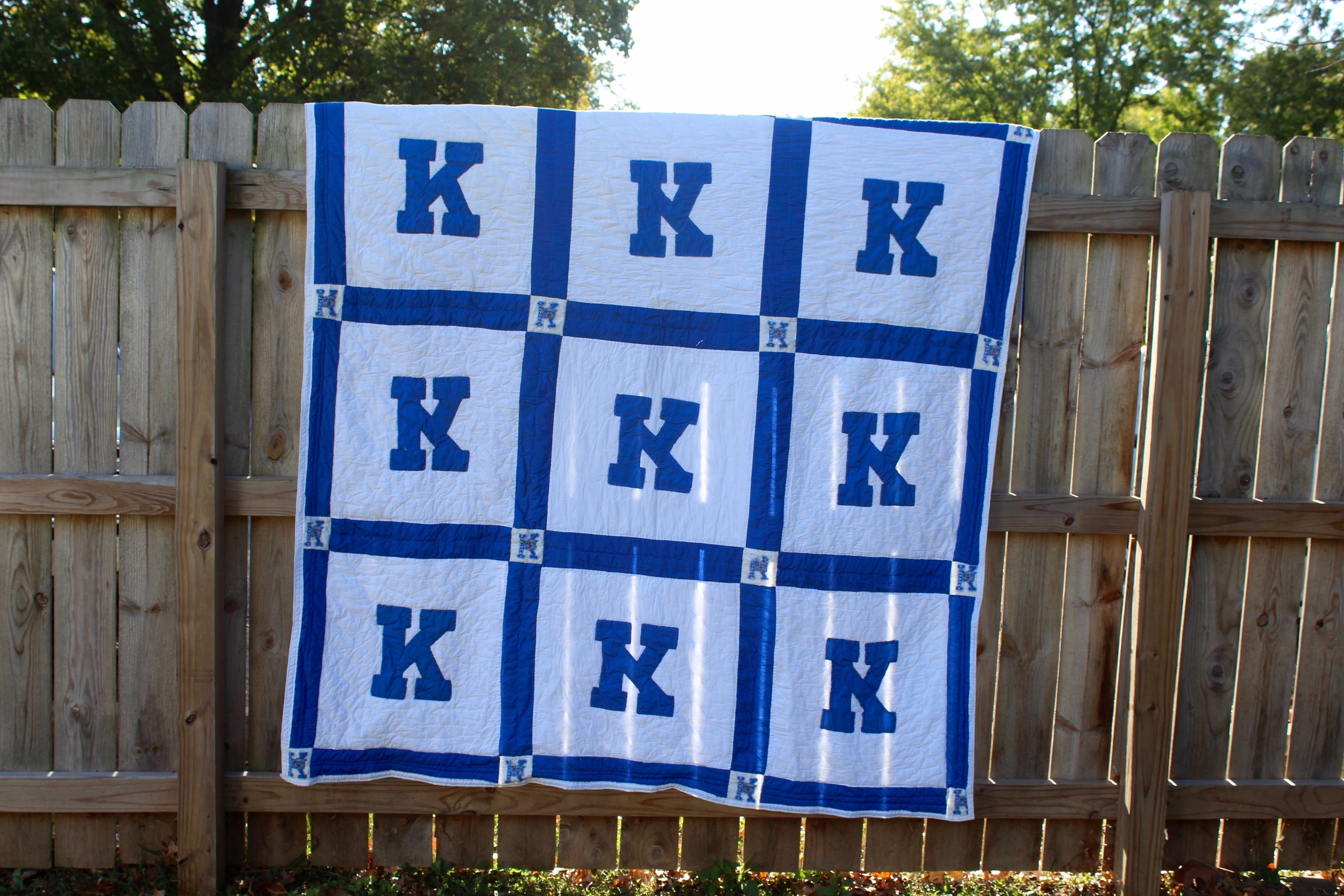
Blue and White Kentucky Wildcats Quilt

Today's Quilt of the Week is in honor of my Wildcats. It's perfect for tailgating or football and basketball season! Go Big Blue!

Paducah's Accidental Preservationists
Our personal home was the beginning. The idea was sound, the plan was naive. Let's buy this old empty house and fix it up, just like on TV! We had no idea what we were starting.
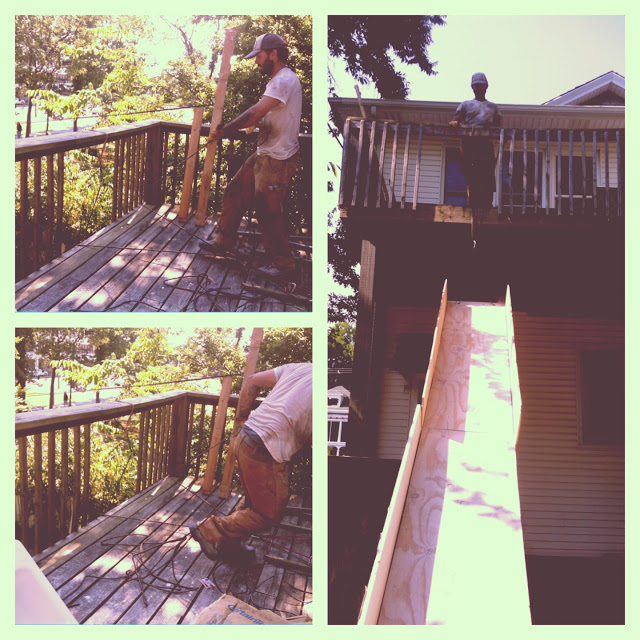
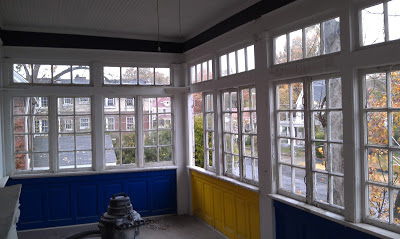
First, we were reminded that TV is not reality. Not even reality TV. Our house restoration was a 2 year process of trial and error, bruised thumbs and egos. But we did it, and we did it pretty well. We learned what most old house owners learn about old plaster walls, wood floors, and wavy glass. We learned about plumbing and electricity and myriad building codes.
But even more importantly we learned new words and ideas: some of the things we learned were big and nebulous like urban infill and green space and city zoning ordinances. Some were much smaller, like how to pick the right height for a banquette.
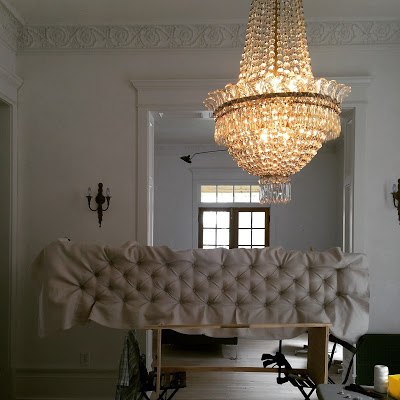
We learned how every old wood window sash is secretly a piece of art. Hand built by a craftsman, just for your house. We learned that lime plaster can heal itself, breathe out water, and last for hundreds of years. We learned that everything moves in a house, just a little, whether you give it room or not. We learned that old houses are the most sustainable houses, if you just give them a chance.
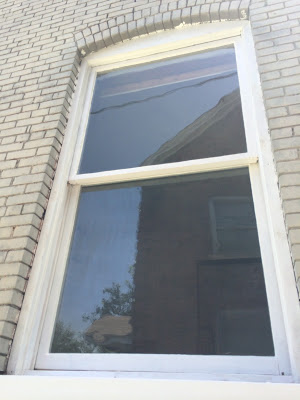
We learned that we are not house flippers, or remodelers, we are historical preservationists. We are ok with that.
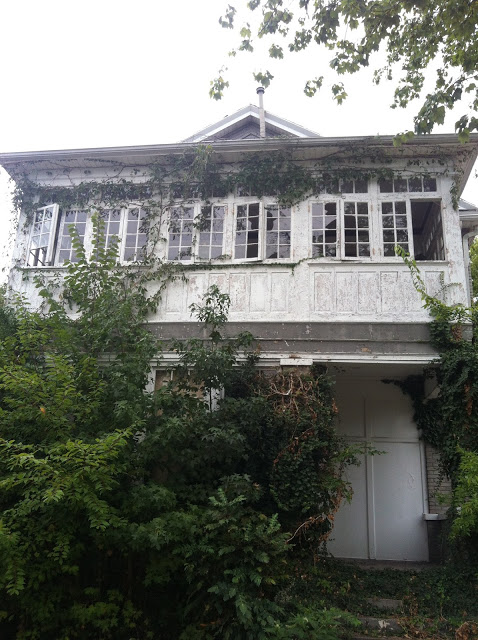
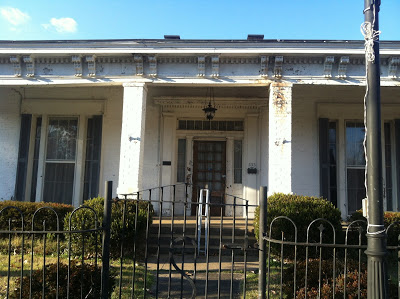
We have taken all those skills and resources and ideas and words and are putting them to use in Paducah. Our big project right now is a building know locally as the Smedley Yeiser.
This is the first time we re-remembered it, back in 2012. Before the vines took it over. Before the city gave up on previous plans for it and offered it for sale for $10,000. Then $1. Before we submitted a proposal and bought it with a golden dollar.
This house is one of the oldest freestanding residences in Paducah and we are the proudest owners we can be. We hope to use the skills we've developed to do it justice. We are approaching it with respect and thoughtfulness. The energy it took to build this house was invested 165 years ago. That's forward thinking and sustainable. We plan to preserve and restore all original features, including the copper roof, and update it to modern standards so that a business could rent it.
We were surprised to find the original chandeliers still work.
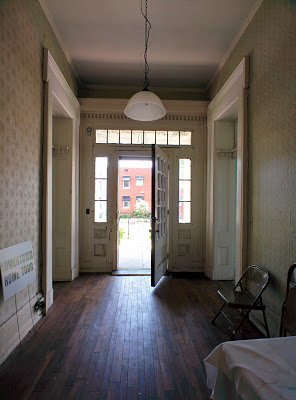
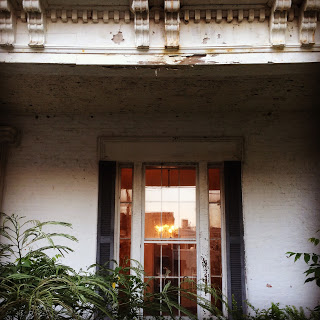
While we've been working on this project, a revered public building has become the source of much controversy in Paducah. Although not nearly as old as the Smedley Yeiser, it is no less significant. Paducah City Hall was designed in the 60s by Edward Durell Stone, a world renowned architect, and was meant to be Paducah's sign to the world that we were progressive. The materials and style harken to the time period and post WWII feelings. It was a time of great innovation, enthusiasm, and optimism and we were presenting ourselves to the world. In many ways it is incredibly ironic because we seem to be at a similar impasse.
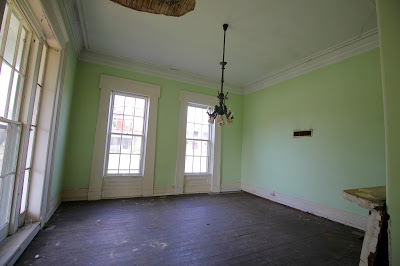
City of Paducah administrators are looking at options for City Hall. We know that with time and passion and hard work Paducah City hall can be restored to it's original beauty. It is a shining example of classic Mid Century design. It has an open layout, a beautiful atrium, and fantastic woodwork. A quick walk inside will reveal a lack of proper maintenance.
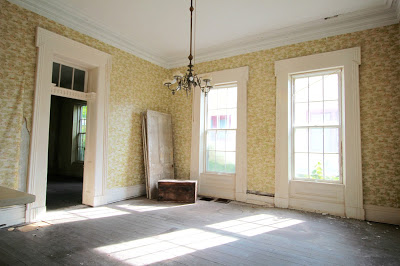
This building sorely needs some preventative care and basic upgrades. We are happy that by getting our friends and community involved, we have convinced our city leaders that this building is worth saving. What remains to be seen is how our city's grand remodel scheme will compare in cost to a new build, and if the public will accept this cost difference. We are concerned they are trying to do too much at once, updating earthquake codes, completely remodeling the interior so that it is a ghost of what it once was. What if we staged the project, fixed it incrementally over several years, and took advantage of the current classic midcentury design that has already come back in style?
We believe this building does not need a full gut renovation, it needs thoughtfulness and creativity. Paducah is a UNESCO creative city. There are twelve in the world and three in North America. Surely we can use some of that noted creativity in this situation.
We have learned from experience that it's often less expensive and easier to take care of what you have, to make updates, and it's definitely the most sustainable option. We believe that with smart choices this is a building we can be proud of for years to come, and it's a more financially responsible project if we are conservative with our choices.


The bottom line: Buildings CAN and SHOULD last hundreds of years. Whether they are pre-Civil War, built in 1917, or even in 1962, we must cherish and preserve our buildings that form the fabric of our history.
So look out, Paducah! Your newest accidental young preservationists are on a mission!
If you agree, let our city leaders know.
http://www.ipetitions.com/petition/save-paducah-city-hall
Lauren and Levi
Follow along on Instagram: @desertmountain @ljax