
January Book Club Part II: The Undertaker's Daughter

Thanks to everyone who's been reading along with The Undertaker's Daughter by Kate Mayfield! Two weeks ago, we talked about the Kentucky themes in the novel. Today, I thought I'd share the Simon & Schuster Reading Group Questions, to get your opinions on these themes. If you're new to the Book Club, please feel free to refer back to the first post, and we'd love to hear your comments on both sets of questions!
1. In what way does the prologue story of the bridge game set the tone for the book? What themes are foreshadowed here? Discuss specific examples and how they relate to later scenes.
2. On page 14, Kate contrasts her father’s appearance and comportment with the stereotypical view of “mortician” or “undertaker.” What images do those words conjure up for you? Did Kate’s father live up to your expectations? Why or why not? Can you imagine yourself in that profession?
3. Discuss Kate’s descriptions of her father’s reverence for death, the dead, and the paraphernalia of death. When did this reverence cross the line to affect his family? In what ways was Frank both selfless and selfish in the sacrifices he made for his business?
4. On page 24, Kate describes a typical family dinner, at which she was admonished not to talk about death at the table, even as her parents “spoke of nothing else.” How was death a taboo in Kate’s family, even as it permeated all aspects of their lives? What other taboos were there among the Mayfields and in the town of Jubilee? What are Kate’s contributions to these secrets, and how do they later lead her to feel as if she is “two people” (page 249)? Are there any ways in which you similarly lead a secret life?
5. Kate experiences funerals from evolving vantage points as she grows up, beginning with her secret perch on the stairs, and later as the organist. Describe the things Kate notices most at different points in her life. What details stand out to you from funerals you’ve attended? What is the main reason Kate agrees to fill in as the organist?
6. Much of what Kate knows about her father’s secrets she learns from family members, friends, and, later, historical records. Why doesn’t Kate simply ask her father these questions? What is the reason Kate eventually learns her father chose his profession? What other events impacted his choice?
7. Kate had several hiding places while growing up. Describe these getaways. What was the most unusual, and why was that her favorite? Share your own secret getaways as a child and why they were important to you.
8. Kate describes only one close childhood friend, a girl named Jo who moves in two doors down from the Mayfield funeral home one summer during their early teens. Why are she and Jo are drawn to each other? How is Jo different from other girls in town? What deeper secrets do we later learn Kate and Jo share? Why does Kate feel she is closer to Jo than to her own siblings?
9. How does the “business of death” (page 43) differ from how we experience death as mourners? How is this underscored by Frank’s description of the different views people have on selecting a casket? How is money sometimes just as much a taboo as death?
10. Frank spends “thirteen years toing and froing” (page 94) Miss Agnes around town, taking her meals on holidays, and seeking her counsel. What effect does this relationship have on the Mayfield family? Why does Lily Tate agree to their arrangement? How does Miss Agnes help Frank’s business, particularly concerning the Old Clan? Why do you think Miss Agnes chose to develop a special relationship with Kate, out of all the Mayfield children?
11. Kate weaves stories of the lives and deaths of the townspeople of Jubilee into her memoir. How do these stories contribute to the flow of the book and our understanding of Kate’s experiences with death? Which one evoked the strongest feelings for you? Choose your favorite of these stories and share the reasons why with your group.
12. The strong reaction to desegregation displayed by adults in her life was incomprehensible to young Kate. Discuss the differences between how blacks and whites in Jubilee lived, died, and grieved. What were the consequences of the intersection of these two worlds? Identify some of the ways that both Frank and Kate cross over this line.
13. Kate first feels the contrast between the smallness of Jubilee and the “great expanse of America” (page 175) during a family trip to the beach. How does Kate’s desire for the freedom of a larger world manifest? Revisit the afternoon where Kate and Jo discover the musician Charles Mingus (page 209). How does this experience solidify Kate’s idea that she might visit or even live in a place far different from Jubilee?
14. On page 274, Kate calls the funeral business “the most segregated business in Jubilee and in the whole of the South.” Do you agree with this claim? Why or why not? Identify other social institutions that Kate observes as heavily segregated in Jubilee during her time there.
February's book club selection will be Whiskey Women by Fred Minnick!

Shrimp and Grits
If you follow HerKentucky on Instagram, then you know I made shrimp and grits for dinner the other night. I usually make this dish Cajun-style, but this time I wanted a lighter flavor profile, so I went with a Lowcountry version. I basically doubled this Bobby Flay recipe and added a shallot.
- 6 cups water
- Salt and pepper
- 2 cups stone-ground grits
- 4 tablespoons butter
- 4 cups shredded sharp cheddar cheese
- 2 pounds shrimp, peeled and deveined
- 12 slices bacon, chopped
- 2 lemons, juiced
- 2 tablespoons chopped parsley
- 1 cup thinly sliced scallions
- 1 large clove garlic, minced
- 1 large shallot, minced
Bring water to a boil. Add salt and pepper. Add grits and cook until water is absorbed, about 20 to 25 minutes. Remove from heat and stir in butter and cheese.
Rinse shrimp and pat dry. Fry the bacon in a large skillet until browned; drain well. In grease, add shrimp. Cook until shrimp turn pink. Add lemon juice, chopped bacon, parsley, scallions and garlic. Saute for 3 minutes.
Spoon grits into a serving bowl. Add shrimp mixture and mix well. Serve immediately.
Potato-Leek Soup
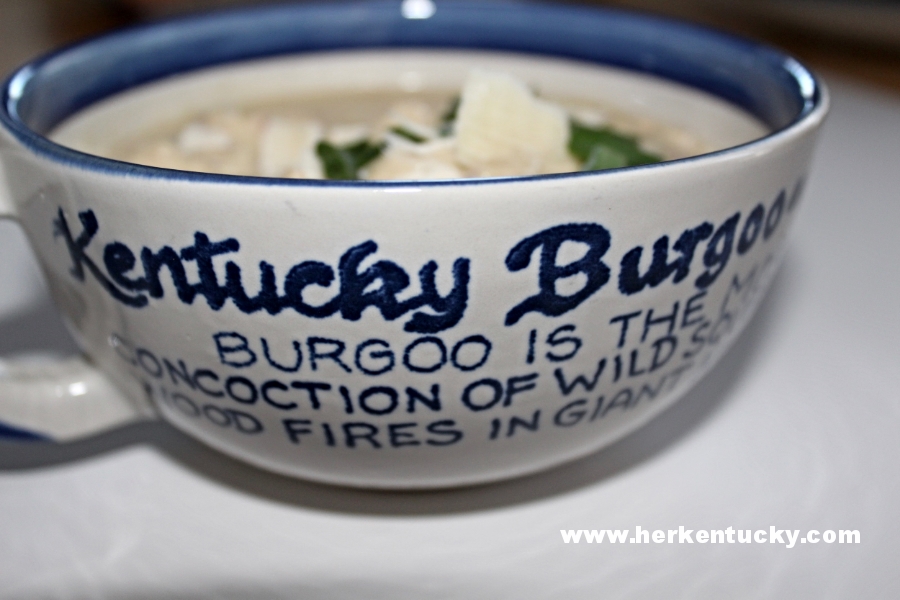
It's no wonder January is National Soup Month. With the cold temperatures and snowy days, I want to make a fresh kettle of soup every couple of days. And, in fact, that's exactly what I've been doing.
I made one of my go-to favorite soups, potato-leek, as the snow fell on Friday. I always stick to this basic recipe. Sometimes I add some pancetta or country ham; sometimes I forget to buy or make stock and use water. This time, I got the bright idea to add a little cayenne pepper for depth. We loved the way the heat of the cayenne played off the smokiness of the bacon!

Potato-leek soup
- 6-7 slices bacon
- 3 leeks, chopped (white and light green portion)
- 3-4 cloves garlic, minced
- 7-8 Russet potatoes, peeled and chopped into quarters
- 64 oz box chicken broth
- 1/3 cup half-and-half
- Kosher salt, freshly cracked black pepper
- 2 tablespoons cayenne pepper (optional)
- Parmesan cheese and scallions for garnish
Cut bacon into lardons. Place in dutch oven over medium heat; cook until bacon is lightly browned and fat has rendered. Add leeks and garlic, cook until translucent (3-4 minutes). Add potatoes; let cook for 10-15 minutes. Add chicken broth (It's better to use homemade stock, but packaged broth will do in a pinch...) and bring to a boil. Reduce heat and let cook for about 25-30 minutes, until potatoes are soft. Season with salt and pepper, to taste.
Using an immersion blender (or a food processor), blend most of the soup, leaving a few chunks of potato. Add half-and-half and let cook another 10 minutes or so before serving. If leaving on the stove for a while, you may need to gradually add water to keep from thickening too much.
Chicken Noodle Soup
Warm up with this classic soup!
A snowy day calls for homemade chicken noodle soup. There's nothing better on a cold day, or when you're feeling under the weather!
I always work from this basic recipe
- 3-4 Bone-in, skin-on chicken breasts
- 1 large (16 oz) bag wide egg noodles
- 4-5 carrots
- 4-5 celery stalks
- 1 onion
- 4-5 garlic cloves
- 1 stick of butter
- salt
- pepper
- olive oil
- garlic powder
- 1 lemon, juiced
- parsley for garnish
- Season chicken breasts with salt, pepper, garlic powder, and olive oil to taste. Place in a large glass baking dish and cook at 375 for 25-30 minutes or until completely done.
- Shred chicken meat, reserving bones, skin, and pan drippings.
- (If using boneless/ skinless chicken breasts, skip this step and use 1 box of pre-made chicken stock) Place chicken skin and bones in dutch oven. Deglaze the baking dish and add pan drippings to dutch oven. Add sliced onion, garlic cloves, 1 carrot, and 1 stalk of celery to dutch oven. Cover with water, bring to a boil, then let simmer for 1/2 hour. Add butter and salt and pepper to taste.
- Remove solids from stock mixture. Add shredded chicken and 3-4 chopped carrots and 3-4 chopped celery stalks.
- Add egg noodles and cook at medium-high heat until the noodles are cooked to taste.
- Add lemon juice; season to taste and add chopped parsley

Martin Luther King, Jr. and the 1964 March on Frankfort
Martin Luther King, Jr.'s lasting legacy in the Bluegrass State
In 1964, Kentuckians were fed up. It was time for citizens of the Commonwealth to be treated fairly. The winds of civil rights reform were blowing across the nation, and citizens of the Bluegrass State were ready for a change.
Frank Stanley, Jr., editor of the Louisville Defender newspaper, organized the March on Frankfort. Stanley recruited baseball legend Jackie Robinson, folk singers Peter, Paul, and Mary, and activist Martin Luther King, Jr. to attend the March, which was held on March 5, 1964.
The following day, the Courier-Journal reported that "The marchers and singers — from the coal mines of Appalachia, the bluegrass of Lexington, the factories of Louisville, the cotton fields of the Purchase — came to press for passage of a stiff and workable public accommodations bill."
Dr. King's speech noted that the crowd had gathered to "challenge the immorality of the social system that permits segregation." His repeated refrain in his stirring speech was that "Now is the time" for change. The March is credited as a catalyst for the passage of the 1966 Kentucky Civil Rights Act, which Dr. King called "the strongest and most comprehensive civil rights bill passed by a Southern state."
For this impact on our Commonwealth, as well as Dr. King's legacy which still resonates throughout our nation fifty years later, we say Thank You, Dr. King!
My Kentucky Tee Bless Your Heart Giveaway
I absolutely love My Kentucky Tee! They're a subscription service that sends a Kentucky-themed tee shirt to your door every month, and the upcoming February tee is just amazing. How Southern and hilarious is the saying "Bless Your Heart"? I mean, everyone knows what you're saying there.
HerKentucky has partnered with My Kentucky Tee to give one lucky winner a Bless Your Heart tee. Just enter to win below!
January Book Club, Part I: The Undertaker's Daughter and Kentucky
Welcome to the HerKentucky Book Club!
January's book is The Undertaker's Daughter by Kate Mayfield. Oh my goodness, did I love this book! It's so quirky, and so quintessentially Kentuckian!
This is such a fun and fascinating book, and I did feel that, even though it could be enjoyed by a very wide audience, there are aspects of the book that are perhaps best appreciated by those of us who've grown up here in the Bluegrass State. So, the format for Book Club this month will be two posts: this week, we'll focus on the Kentucky connections to The Undertaker's Daughter; in two weeks (Thursday the 28th), we'll focus on more thematic, traditional book club questions. Please feel free to comment below, and encourage your friends to pick up with us for the month's second post!
Here are the thoughts and questions that arose for me as I read the book. I'd love to hear your perspective on any of these themes, as well as any discussion you'd like to start! Feel free to discuss in the comments section below this post!!
1. I absolutely loved this passage from Chapter 2: "There were no Appalachian Mountains in this town, nor coal miners, hillbillies, or holler dwellers. Neither were there white fences bordering exclusive horse farms, nor tony Derby breakfasts. It was just a sleepy, little tobacco town..." Did you, as a reader, feel that this description set you in mind of a very specific corner of Kentucky?
2. The story is set in the fictitious Jubilee, in Beacon County, near Lanesboro, yet it isn't all that hard to figure out which Southern and Western Kentucky towns the author is actually referencing. Did you find that this slight fictionalization within the memoir was distracting? Were you googling to see where Mrs. Agnes Davis and the Bibb House Museum were actually located?
3. The Undertaker's Daughter is set in a truly bygone era. I found myself thinking of Southern novels like The Divine Secrets of the Ya-Ya Sisterhood and The Help in everything from the Jubilee townspeople's views on race to the ladies' devotion to hairspray and proper bridge party food. Lily Tate and her friends' views on Northerners and Catholics felt exclusionary, while the townspeople's views of African-Americans were outright racist. Do you feel like this is an accurate depiction of the attitudes in small Kentucky towns in the 1960s? Do you think things have changed in the past 50 years or so?
4. The depiction of small-town Kentucky life in The Undertaker's Daughter was realistic felt very believable that everyone in Jubilee knew each other's business and the middle class folks gossiped about the Country Club set. Because of this, I often found myself (also a small-town Kentucky girl) gasping when the narrator told her family's secrets. As a writer, I often have that reaction to memoirs that air the writer's dirty laundry, like the works of Pat Conroy. Did you find the small-town setting made the author's revelations of family mental illness, substance abuse, and infidelity more shocking?
5. There's a great line early in The Undertaker's Daughter where the narrator vows that she will not become one of Beacon County's widows. Time and again, she references getting out of Jubilee and making a life for herself elsewhere. Could you relate to young Kate's desire to flee small-town Kentucky and see the world? Were you surprised to learn that she now lives in England?
I can't wait to hear what y'all have to say about these questions, or any other thoughts and ideas you may have about the book!